

Larger blue bins (Rollout from July 2026 onwards)
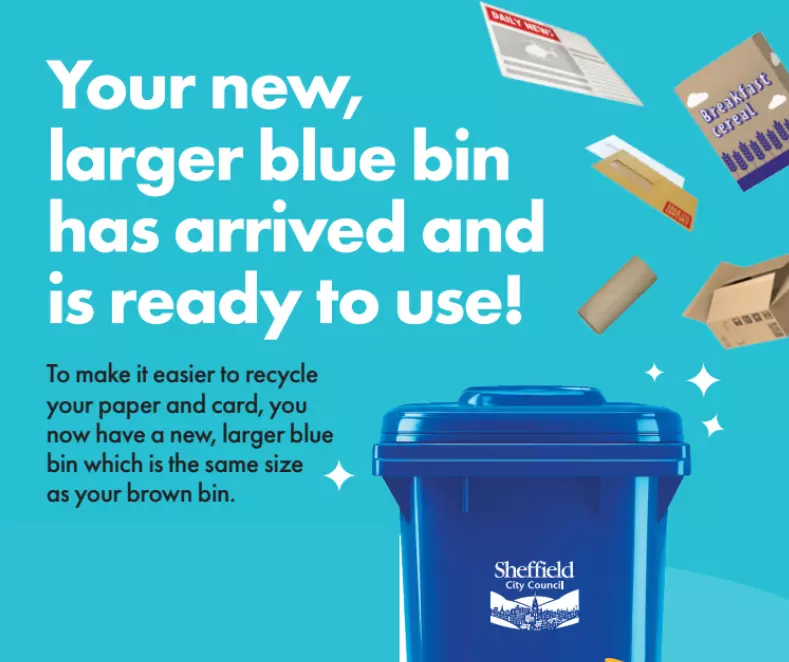
The rollout project started in July and is planned to run for 19 weeks until December, with a huge 216,000 blue bins being delivered across the city.
You can check what date your new blue bin is due to be delivered by searching for your postcode on the document below.
Postcodes are listed in numerical order.
If your smaller (140l) blue bin has been collected but your larger (240l) blue bin has NOT been delivered, please log your address using the button below.
We advise you to wait up to 48 hours after the day your blue bin has been emptied, before registering that your new bin has not been swapped or delivered.
Our crews will be putting tags on your black bin a week before your new 240l blue bin is delivered.
You can use this tag to show us that you want to keep your 140l blue bin for storage by ticking the box and leaving it on your 140l blue bin.
Only 240l blue bins (bigger blue bin) will be emptied by our crews in the future, please only use your 140l blue bin (smaller blue bin) for storage or other uses.
See below the dimensions of the new bigger bin compared to the smaller bin

1. Will I be receiving a smaller bin?
No, a roll out to replace 140l blue bins with 240l blue bins will begin in July 2026 and will be for all Sheffield City Council residents. You can choose to keep your 140l to be reused for other things such as a water butt, or it can be collected by Veolia on the day when your larger blue bin will be delivered.
2. How many bins will I have?
Currently, all Sheffield residents living in houses have a blue bin for paper and card, a brown bin for dry recycling and a black bin for general waste. This will not change in the near future, as food waste collections have been delayed until at least 2038.
The only change to the size or number of bins will be the replacement of a 140l blue bin with a 240l blue bin from July 2026.
1. What new materials can I now recycle?
You can now recycle the following items as part of your household recycling collection in your brown bin for houses/some flats and green bin for all other flats:
Clean aluminium foil e.g. kitchen foil and foil trays
Clean plastic pots, tubs and trays e.g. yoghurt pot, margarine tub, fruit punnet
Rinsed cartons e.g. food and beverage cartons such as those used for juice, plant-based drinks, milk, soup and sauce cartons
Squeezed and empty plastic and metal tubes e.g. toothpaste and cosmetic tubes
Empty aerosols e.g. deodorants, hairsprays, shaving foam and air fresheners
2. Why are these changes happening? / Why is the recycling service changing?
These changes are part of the Government’s Simpler Recycling requirements, which comes into effect from 31st March 2026. This aims to make recycling collections across England more consistent, so everyone can recycle the same materials, reduce confusion and improve recycling rates.
3. Why should I recycle?
Recycling is the most environmentally friendly way to dispose of packaging. Putting something in your black rubbish bin means it will end up in landfill or incineration, but recycling gives that material the best chance of staying in use. If every household in the UK recycled just one more item each week, we could save enough energy to power over 500,000 UK homes for a year.
4. What happens to my recycling?
Recycling taken from your brown bin (houses) and green four wheeled bin (flats) is taken to Derbyshire Materials Recovery Facility, where recycling is separated into glass (by colour), metal (steel and aluminium) and plastics (by type). The materials are then taken to re-processors to be used to make new products which end up back in the shops and back into your home.
5. Is there a charge for a replacement brown bin if it is damaged or goes missing?
There will be no charge for a replacement brown bin if the bin is damaged/missing or stolen.
6. Can I refuse to use the brown bin and have it removed?
No, to ensure that you are able to manage your household waste correctly you need to separate your waste into your brown, blue and black bins.
7. Can I put extra waste at the side of the brown bin?
No, because it is not safe for our operatives to be handling glass not presented in the bin, please ensure all your glass, cans and plastic bottles are in the bin. If your collection is delayed due to bad weather or Bank Holidays we may take extra cans and plastic bottles only. All glass must be in the brown bin. Also, extra recycling can be taken to your local bring site, please see Veolia’s website for further information.
8. Can I have any larger or additional brown recycling bins?
Currently, unless you qualify as a larger household you will only be entitled to one brown bin. At the end of this year, residents will be offered the choice of having an extra brown bin, but this will not be possible until the end of the year.
9. How do I recycle foil?
- Make sure your foil is clean and free of food
- Wipe or rinse foil trays
- Remove any plastic lids or packaging
- Scrunch clean foil into a ball
- Place in your mixed recycling bin (brown bin for houses/some flats and green bin for all other flats)
10. Why should I recycle my foil?
Aluminium foil is infinitely recyclable. Recycling it:
- Uses 95% less energy than making new foil
- Helps create new products like bike frames, car parts or new foil
- Is cheaper and better for the environment than disposal
- Keeps valuable material out of landfill or energy from waste facilities
11. What if I’m not sure whether something is foil or plastic?
If you're unsure, do the scrunch test: scrunch it in your hand. If it stays scrunched, it's foil and can be recycled. If it springs back, it’s likely plastic. Please put it in your black bin (general waste).
12. How do I recycle plastic pots, tubs and trays?
- Make sure plastic pots, tubs and trays are empty and contain no food
- Rinse your plastic pots, tubs and trays
- Plastic yoghurt pot plastic film lids should be removed and put in the black bin
- Margarine tub lids etc, can be left on
- Place in your mixed recycling bin (brown bin for houses/some flats and green bin for all other flats)
13. What does plastic pots, tubs and trays include?
- Yoghurt pots
- Margarine tubs
- Plastic sweet tubs
- Plastic ice cream tub
- Fruit punnet
- Meat tray
- Ready meal tray
All need to be empty, clean and dry before recycling.
14. How do I recycle cartons?
- Rinse your cartons to remove leftover liquid
- Leave the cap on – it can be recycled
- Place in your mixed recycling bin (brown bin for houses/some flats and green bin for all other flats)
15. Why should I recycle my cartons?
Cartons are made from cardboard with thin layers of plastic or foil and recycling them:
- Saves trees, water and energy
- Reduces disposal costs and is better for the environment
- Help make cardboard boxes, construction boards and even furniture
16. How do I recycle tubes?
- Squeeze out any remaining product so the tube is empty
- Leave the cap on – it can be recycled
- Place in your mixed recycling bin (brown bin for houses/some flats and green bin for all other flats)
17. Why should I recycle my tubes?
Many tubes e.g. toothpaste or hand cream are made from recyclable plastic or metal. Recycling them:
- Reduces the amount of non-degradable waste in landfill
- Saves energy used to make plastic/metal from scratch
- Helps create new packaging or household items
18. What are the new tubes made from/why can I now recycle tubes?
The tubes are now produced from the same type of plastic used in everyday packaging like milk bottles and bleach bottles. This is either:
- Mono-PE (HDPE or LDPE) or Mono-PP
Both materials have been improved in recent years to ensure they can be widely recycled.
19. What happens to the tubes once recycled?
When placed in your household recycling bin (mixed recycling bin - brown bin for houses/some flats and green bin for all other flats), the tubes can be processed and given a second life as new plastic or metal packaging/products.
20. How empty does the toothpaste tube have to be and how best to empty it effectively?
The emptier the better. WRAP testing shows that the emptier the tube, the easier it is for it to be separated for recycling.
21. Should the tube be rolled up or flattened?
Please keep your tubes flat when recycling, not rolled. Rolling will mean that the tube is smaller and will run the risk of not being recovered for recycling.
22. How do I recycle aerosols?
- Make sure aerosols are completely empty
- Leave the cap on - it can be recycled
- Place in your mixed recycling bin (brown bin for houses/some flats and green bin for all other flats)
23. Why should I recycle my aerosols?
Aerosol cans are typically made from aluminium or steel, both of which are highly recyclable. Recycling aerosols:
- Saves raw materials and significant amounts of energy
- Helps produce new aerosol containers, car parts, and metal components
- Prevents potentially hazardous materials from entering landfill or the environment
24. Why is it important to clean items before recycling?
Food and drink leftovers can contaminate other surrounding recycling, making it harder to sort and lowering the quality of material. Cleaning recyclable materials before putting in your recycling bin, helps ensure more materials can be recycled successfully.
25. What happens to the foil, plastic pots, plastic tubs, plastic trays, cartons, tubes and aerosols I recycle?
These materials are sent to recycling reprocessing facilities where they are sorted into different material types and transformed into new products such as car parts, construction materials and new packaging materials.
Recycling these items saves energy, conserves natural resources and helps keep valuable materials in circulation for longer.
26. Does recycling really make a difference?
Yes! Recycling is worthwhile and helps reduce pollution, save energy and conserve natural resources. It also supports jobs in the UK’s recycling, processing and manufacturing industries.
27. How can I improve my recycling?
You can improve your recycling by checking what can be accepted in your household collections and by only putting in those items that Sheffield City Council and Veolia specifically ask for. For items not collected at kerbside check the Recycle Now recycling locator.
28. Where can I find more information about what I can recycle?
To find out more about what you can recycle visit www.sheffield.gov.uk/bins-waste-recycling/about-your-bins, where you can find a full list of accepted materials.
You can also look out for updates on Twitter @Recycle4Shef
29. Why should I bother recycling if some people don’t?
Many people in Sheffield City already recycle. By doing your part, cleaning, sorting and recycling your waste, you’re making a big difference. It helps reduce waste, increase recycling, turn old materials into new products and protect our environment.